Observation 001
In a real BMS record, a whole-pack response body does not remain one fixed organisation through use.
BMS Research Observatory / a real-vehicle record / per-cell voltage and temperature channels
LFR aligns telemetry, public records, sensor channels and operational logs — without allowing one source to complete a story it cannot support. We show what is visible, what remains unresolved, and what evidence should be requested next.
For asset review · technical due diligence · portfolio monitoring · underwriting evidence review
A dashboard reports one view. A data room describes the asset. LFR examines how multiple records hold together through time — and returns it in forms a review can actually file.
Which records in a real asset basket require reconciliation.
Single assetHow one asset’s visible operating rhythm has moved through time.
Next questionWhat owner-held records should be requested to close an open question.
How every released observation can be traced and checked by another competent party.
We do not turn an unresolved observation into a verdict. We turn it into a bounded question and a specific evidence request.
Every engagement returns the same artifact class, judged on the same five properties.
Public grid records show part of what grid-connected assets are seen doing: their visible cadence, direction, volume, declarations, metered presence and operating context. LFR preserves those records continuously and turns them into authorised portfolio and asset reviews. Not asset health, dispatch causality, or a reliability forecast.
Dated system cards, anonymous public-duty archetypes, source capability, maturity horizons, reproducible methods, and the explicit boundary between a public question and an internal answer.
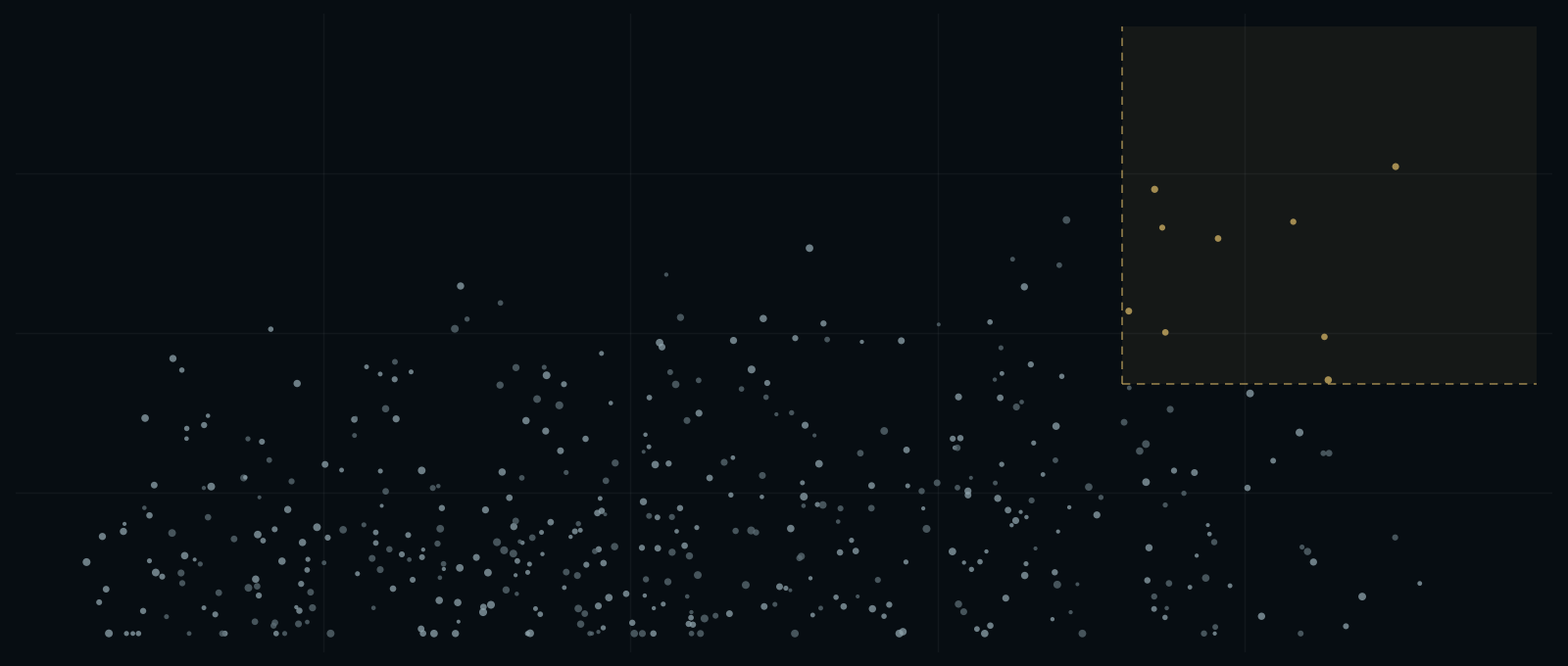
Public BMRS accepted actions reveal how each asset is called: persistently, briefly, direction-switching, or episodically. The public lens shows the anonymised fleet field and what a footprint can justify asking; a named cadence profile is produced under authorisation, checked against your own instrumentation.
Public half-hour NESO data replayed as a moving power-flow organisation projection: the system-level field behind which individual assets carry their share.
Public specimens: Storage Fleet Duty Mirror · Grid Continuity Status Card Paid surfaces: Portfolio Status Sheet · Targeted Evidence Request Pack
Current form: fileable HTML/PDF review · pilot-stage delivery · every figure recomputable.
LFR is not defined by one sensor, dataset or industry. We work with real systems represented through multiple, incomplete channels. In each application, the lenses, clocks, identities and buyer workflow change. The observation discipline remains the same.
Real system → multiple incomplete channels → source capability and time registration → cross-channel alignment → visible observation and unresolved residual → evidence request → recomputable review record
The first commercial implementation is GB Grid and storage. Other applications enter the product layer only when their channels, buyer and evidence workflow are real.
Six steps, identical in every domain. The GB Grid implementation documents each one against its exact public sources.
No joined observation is stronger than its weakest identity or time bridge. Read the full method →
A portfolio under review. A submitted number without a clear evidence boundary. Two records that do not agree. A system whose dashboard does not explain what it has been carrying.
We do not provide asset ratings, failure predictions, underwriting conclusions or generic dashboard development.
Short records from work already underway. Interpretation follows observation; unresolved structure remains unresolved.
In a real BMS record, a whole-pack response body does not remain one fixed organisation through use.
BMS Research Observatory / a real-vehicle record / per-cell voltage and temperature channels
Scalar-matched battery pairs can occupy different observed response organisations.
Battery Organisation Observatory / Mirror Live Skin and Residual Atlas
Organisation changes around visible transition can remain observable without resolving a material mechanism.
ECI 72 Materials Workspace / DEM pipeline, 72 runs across six inclusion fractions
In a lab pack under WLTP, cells quietly lock into fixed roles, while flat capacity shows nothing.
Pack Reachability / a controlled lab pack, role-flow and possibility corridor
In local Alethia runtime probes, captured audio and phase-lock are recorded alongside field familiarity, tension, coherence, and permission.
Alethia / real-time audio runtime / 120 second baseline and intervention probes recorded 2026-05-09
Three observation eyes behind the products: a controlled lab cell, a lab pack under WLTP, and a real vehicle. Each evidenced on real data, none replacing SOH.
Cycler-collected 18650 cells observed for recurrence, residual, and role separation. The reproducible metrology basis for “same SOH, different organisation.”
Open controlled experimentsA 36-cell lab pack under WLTP, observed as role reachability and a possibility corridor: which cells carry load, whether substitutes remain, and where roles lock — invisible to flat pack capacity.
A local real-time runtime with recorded audio probes, phase-lock, memory-field influence, ethical tension, and permission gating; additional physical modalities remain in development.